
Search visibility is no longer just about ranking. It’s about being discovered.
Modern search systems are designed to interpret, summarize, and select content before a user ever clicks. AI-driven discovery has changed what it means to be visible, and many sites are still optimizing as if search engines only retrieve pages instead of understanding them.
In this article, we’ll look at what modern search systems need to understand your content, how AI-driven discovery changes visibility, and why clarity now matters more than ever.
How Modern Search Systems Actually Work Today
Modern search systems do more than match keywords to pages. They attempt to understand:
- What a page is about
- Who it is for
- What problem does it solve
- How it relates to other information
This understanding is what powers AI-driven features like AI snippets, summaries, and expanded SERP layouts. If a system cannot confidently interpret your content, it is unlikely to surface it in these discovery surfaces.
Why AI-Driven Discovery Changes SEO Fundamentals
AI discovery shifts search from retrieval to interpretation.
Instead of asking, “Which page should rank?” systems increasingly ask:
- Which content best explains this topic?
- Which source can be summarized accurately?
- Which page fits this query context right now?
This means pages are no longer competing only for clicks. They are competing to be understood well enough to be reused. Take my AI conversation above for example, this blog will likely rank for conversational topics related to this article. This is one example of how you can take advantage in the new world of search.
AI Snippets and New SERP Layouts Explained
AI Snippets
AI snippets summarize information directly in search results. They pull from multiple sources and often answer the query without a click.
Instead of ranking a single page, search systems pull information from multiple sources and combine it into an answer. In many cases, the user gets what they need without clicking through to a website. These snippets are not simple excerpts. The system is interpreting the query, deciding what information is relevant, and synthesizing a response that fits the context of the search.
For your content to appear in AI snippets, clarity matters more than completeness.
Pages that perform well here tend to share a few traits. They are clearly structured, with headings and sections that make the main idea easy to identify. They answer a specific question early and directly, without forcing the system to wade through background or mixed intent. They also avoid ambiguity. When a page tries to serve multiple audiences or hedge too much, it becomes harder to summarize cleanly.
Content that rambles or buries its point often gets skipped, even if it is accurate. Not because it is low quality, but because it does not resolve intent efficiently enough for summarization.
AI snippets favor content that is focused, direct, and easy to interpret. The easier it is for a system to understand what you are saying and why it matters, the more likely that content is to be used.
So, for your content to appear in AI Snippets, it must:
Be clearly structured
Answer a specific question quickly and cleanly
Avoid ambiguity or buried context
Pages that ramble or mix audiences are difficult to summarize and often ignored.
Expanded SERP Layouts
Modern SERPs (Search Engine Results Pages) now include:
- AI-generated summaries
- Follow-up questions
- Comparison blocks
- Contextual refinement prompts
Expanded SERP layouts refer to search results pages that no longer present information as a simple list of links. Instead, results are distributed across multiple visual and functional components such as:
AI summaries, carousels, product grids, local packs, videos, images, and interactive elements.
In these layouts, visibility is not limited to ranking first. Content can be surfaced, summarized, or referenced in several places on the page, each serving a different type of intent. A user might scan an AI summary, glance at a carousel, compare options in a grid, and only click if something feels relevant or trustworthy.
This changes what it means to “perform” in search. Success is no longer just about driving traffic to a single page. It is about being present and legible across the surfaces where decisions are being shaped.
Expanded layouts also force search systems to rely more heavily on interpretation. The system has to decide not only which pages are relevant, but how to break content apart, where it fits visually, and how it relates to other results on the page. Pages that are clearly structured and tightly scoped are easier to reuse across these layouts.
Content that depends on linear reading or buried context struggles here. When information cannot stand on its own, it is harder for the system to place it into a card, snippet, or comparison view. As a result, some pages may rank but remain invisible within the broader layout.
Expanded SERP layouts reward content that is clear. The more easily your content can be understood in pieces, the more opportunities it has to appear across modern search results, even when traditional clicks decline.
So, for your content to appear in expanded SERP layouts, it must:
Anticipate related questions
Clearly separate concepts
Provide strong topical signals
Content that tries to do everything at once becomes harder to surface in these environments.
Where Most Content Fails Modern Discovery
Too Much Information, Not Enough Meaning
Many pages contain a lot of information but little clarity. AI systems struggle with content that:
- Mixes multiple intents
- Targets multiple audiences
- Lacks clear structure
This makes summarization risky and selection unlikely.
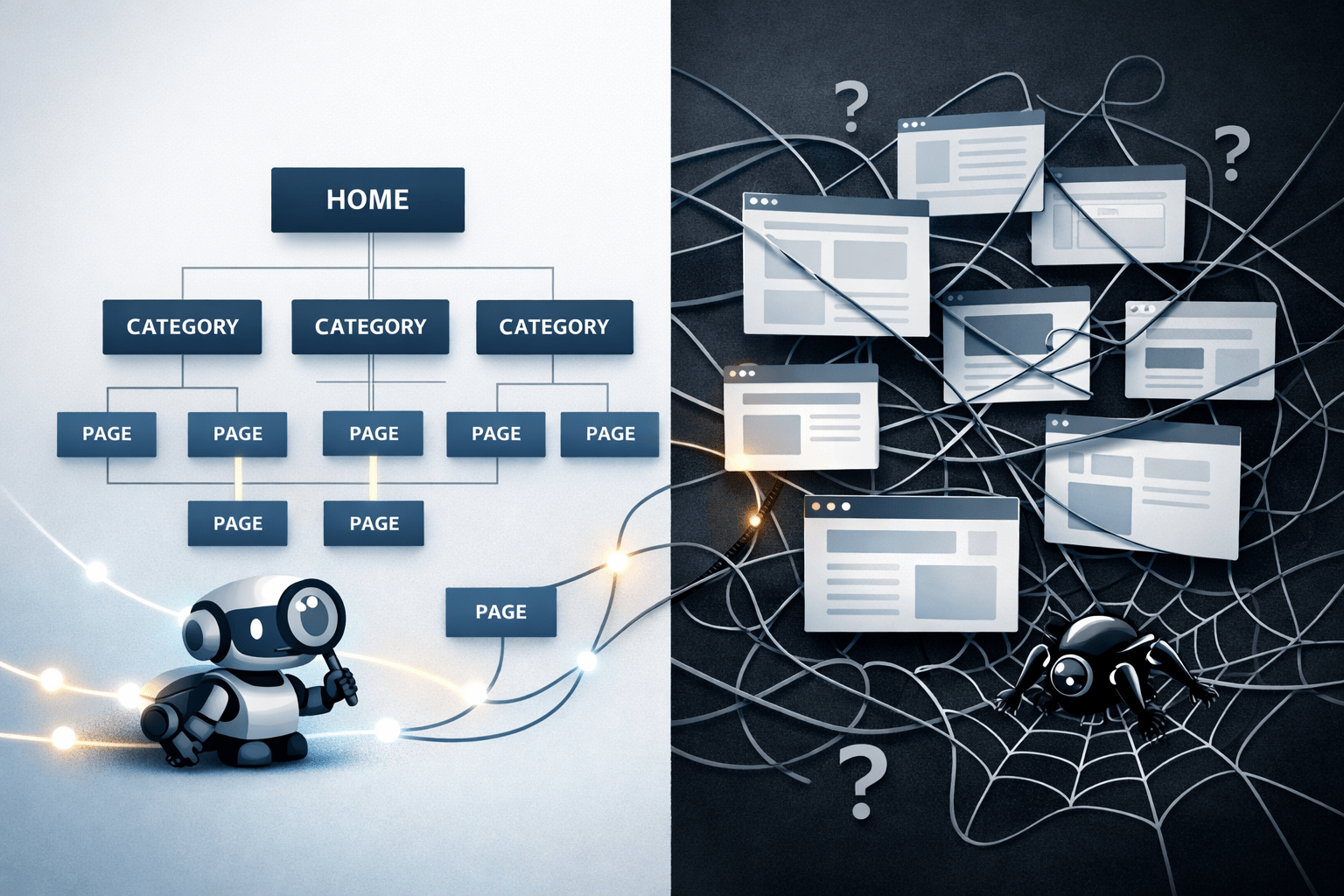
Structure That Assumes a Human Reader Only
Content written purely for linear reading often fails in AI-driven discovery. Systems need:
- Clear sections
- Direct answers
- Obvious topical boundaries
Without these, even high-quality content can be overlooked.
What Modern Search Systems are looking for instead:
Clearly states what it is about
Answers questions directly
Maintains consistent intent throughout the page
Connects cleanly to related topics
This does not mean oversimplifying. It means reducing interpretive friction.
How to Build Content That AI Systems Can Understand
Write With Interpretation in Mind
Assume your content may be:
- Summarized
- Quoted
- Compared
- Shown without context
Each section should stand on its own and still make sense.
Structure Content Around Questions and Concepts
Questions and concepts are key, because they can:
- Match clear query intent
- Group related ideas logically
- Avoid unnecessary narrative detours
This improves both human comprehension and machine interpretation.
Support Understanding With Internal Context
Internal links help systems understand relationships between topics. When you link:
- Supporting concepts
- Deeper explanations
- Adjacent systems
Look for:
- Changes in impression patterns
- Visibility across multiple query types
- Growth in informational and mid-funnel queries
- Increased assisted engagement
AI-driven discovery often shows up as broader visibility, not immediate clicks.
Common Mistakes to Avoid
- Writing for keywords instead of clarity
- Mixing multiple intents on one page
- Ignoring structure in favor of prose
- Treating AI features as optional
These mistakes make content harder to interpret and easier to skip.
Interested in the psychology behind how people search? This page explores how search behavior and user intent shape what people look for, how they phrase queries, and how modern search systems interpret those patterns.
Conclusion
Modern search systems do not just retrieve content. They interpret it.
If your content cannot be easily understood, summarized, or placed into context, it will struggle in AI-driven discovery environments, regardless of how well it ranks traditionally. Clarity is now a competitive advantage.
The goal is no longer just to be found. It is to be understood.
👍0❤️1👏1🎉0🙏0😢0
Guided Discussion (Beta)
View Transcript
This conversation is guided by AI using the ideas and frameworks developed around the idea of this specific article: How AI-driven search systems discover and understand content. I use my own writing as context to prompt the discussion, helping it focus on patterns, connections, and real-world behavior for this specific topic. AI helps keep that context consistent, so the conversation builds on shared understanding instead of resetting each time. Cheezy, I know, just having some fun with it. Pretty crazy times we’re living in…
Frequently Asked Questions About AI-Driven Search Discovery
What is AI-driven search discovery in SEO
AI-driven search discovery is how modern search systems interpret meaning, intent, and context using machine learning models instead of relying only on keyword matching and rankings. It affects how content is summarized, cited, and surfaced across AI snippets, assistants, and blended SERP layouts.
How does AI-driven search discovery change SEO strategy
AI-driven discovery shifts SEO from optimizing for rankings to optimizing for understanding and selection. Content must be clear, structured, and intent-aligned so systems can confidently extract and reuse information across different search surfaces.
What is the difference between AI-driven search and traditional search
Traditional search focused on retrieving and ranking pages. AI-driven search focuses on interpreting queries, synthesizing information from multiple sources, and deciding what content best resolves intent, often without a click.
How do AI snippets work in Google search
AI snippets analyze a query, identify its underlying intent, and generate a summarized response using information pulled from multiple sources. They favor content that answers questions directly, uses clean structure, and avoids mixed or unclear intent.
Why is my content not showing up in AI snippets
Content often fails to appear in AI snippets when it is overly long, mixes audiences, buries answers, or lacks clear structure. Even high-quality content can be skipped if the system cannot easily identify what question it answers and where the answer lives.
How do you optimize content for AI snippets
Optimizing for AI snippets means writing content that resolves a specific question quickly, uses descriptive headings, and keeps each section focused on a single idea. Clarity and scope matter more than length or keyword density.
Do AI search features reduce organic traffic
AI search features can reduce direct clicks when answers are resolved in the SERP. At the same time, they can increase visibility, authority, and brand recognition when content is consistently referenced or cited across AI summaries and expanded layouts.
Is SEO still worth it with AI search results
Yes, but the role of SEO has changed. SEO now focuses on making content understandable, trustworthy, and reusable across AI-driven discovery systems rather than only driving clicks from rankings.
How does AI search affect content strategy
AI search rewards content that is clearly structured and intent-specific. Content strategies that rely on long narrative buildup or broad catch-all pages often struggle because the system cannot easily extract or reuse the information.
What types of content work best for AI discovery
Content that answers specific questions, explains concepts clearly, and separates ideas into focused sections performs best. Educational, explanatory, and comparison-style content tends to surface more reliably than vague or promotional material.
How does AI interpret search intent
AI systems infer intent by analyzing query language, context, historical behavior, and related searches. They aim to understand what the user is actually trying to accomplish, not just what words were typed.
Why does search visibility change without ranking changes
Visibility can change even when rankings stay the same because AI summaries, carousels, and blended layouts may surface or suppress content independently of traditional positions. Being understood matters as much as being ranked.
How do expanded SERP layouts affect SEO performance
Expanded SERP layouts distribute visibility across many components such as AI summaries, local packs, videos, and product grids. Success depends on how well content can be reused and placed within these different surfaces.
What is selection bias in AI search systems
Selection bias occurs when AI systems consistently favor content that is clearer, simpler, or easier to summarize. Pages that require heavy interpretation or context are less likely to be selected, even if they are accurate.
How should SEO measurement change for AI-driven search
SEO measurement should focus less on rankings alone and more on visibility patterns, citations, impressions, and how often content appears across different SERP features and discovery surfaces.
How do you tell if AI search understands your content
Signals include whether content is summarized accurately, referenced in AI features, or surfaced consistently for related queries. Misinterpretation often shows up as partial summaries or exclusion from AI-driven results.
Is AI-driven search the same as Google SGE
Google SGE is one implementation of AI-driven search discovery. The broader shift applies across search engines, assistants, and platforms that interpret and synthesize content using large language models.
How do AI assistants choose which sources to cite
AI assistants tend to cite sources that are clear, well-structured, and consistently aligned with the question being answered. Ambiguous or overly complex pages are less likely to be referenced.
Does keyword research still matter for AI search
Keyword research still matters, but it is used to understand questions and intent rather than to place exact phrases. Long-tail queries help identify how people frame problems and what explanations they are seeking.
What does SEO look like in an AI-first search environment
SEO in an AI-first environment focuses on helping systems understand content, trust its accuracy, and reuse it confidently across summaries, answers, and discovery interfaces.
Thank you for reading. See related posts below. 📖













Join the conversation!