
We tend to think transactional pages are the easy part of SEO. Someone searches with the intent to buy, lands on a page, and converts. In reality, transactional intent is where many sites fail hardest.
Not because the user is not ready.
Not because the page does not rank.
Most transactional pages are built as endpoints. They should be built as confirmations.
In this article, we’ll focus entirely on transactional search intent, why it breaks so often, and how to fix it by aligning expectations, trust signals, and intent progression.
Compare the differences between informational and transactional pages side-by-side
What Transactional Search Intent Actually Means in Practice
Transactional search intent signals readiness to act.
Quick Recap of Search Intent Terminology Before We Continue
Transactional search intent represents the final stage of how people move toward a decision, but it depends heavily on everything that comes before it. Informational searches help users orient themselves and understand a problem, while commercial investigation searches allow them to compare options, evaluate tradeoffs, and reduce risk. Navigational searches signal familiarity and trust. When users are trying to reach a specific brand or destination, they already recognize. Transactional searches come last, when someone is ready to act but still needs reassurance that their choice is correct. Problems arise when transactional pages are built in isolation, without accounting for the understanding, evaluation, and trust that should already exist upstream.
4 Types of Search Intent
Every search falls into one category. Match your page to user intent or lose the click.
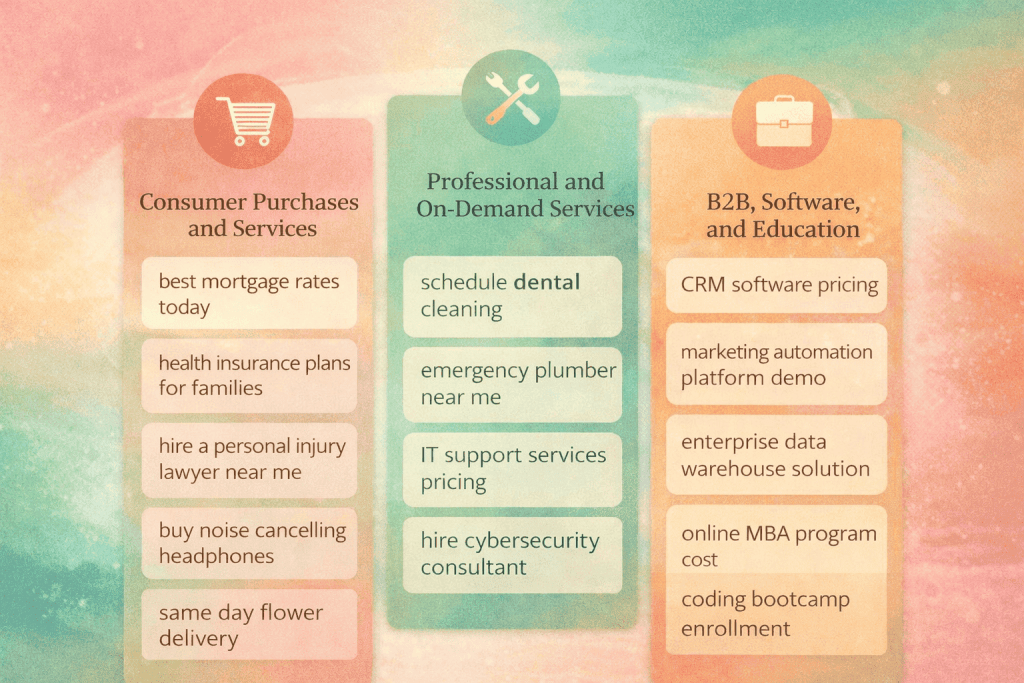
Random Transactional Search Examples by Industry:
In service-based industries, transactional searches include phrases like “schedule dental cleaning,” “emergency plumber near me,” “IT support services pricing,” or “hire cybersecurity consultant.” These queries often appear when urgency is high and tolerance for friction is low. Users are not exploring options casually; they are selecting a provider who can solve a problem quickly and reliably.
Transactional intent often shows up in consumer-focused searches like “best mortgage rates today,” “health insurance plans for families,” or “hire a personal injury lawyer near me.” In everyday purchases, this includes queries such as “buy noise cancelling headphones,” “best king size mattress,” “same day flower delivery,” or “book flight to New York.” These searches signal readiness to act, with users looking to confirm price, availability, or provider trust before committing.
Transactional intent in B2B and professional contexts looks slightly different but follows the same pattern. Examples include “CRM software pricing,” “marketing automation platform demo,” “enterprise data warehouse solution,” or “accounting software for small businesses.” In education and career services, users search for things like “online MBA program cost,” “coding bootcamp enrollment,” or “resume writing service pricing.” These queries indicate evaluation is nearly complete and the user is preparing to move forward.
But transactional does not mean “convinced.” It means the user is close enough to act if the remaining doubts are resolved. That distinction matters.
Why Transactional Intent Is a Big Deal for SEO
Transactional queries are high value, but they are also high risk.
When these pages fail:
Users do not browse
They do not explore
They leave quickly
Search systems notice this.
Google does not just evaluate whether a page matches a query.
It evaluates whether the page satisfies the expectation that query implies.
When transactional pages underperform, the issue is rarely traffic. There is a mismatch between what the user expects to confirm and what the page actually delivers.
Transactional Intent Breaks When Pages Assume Too Much
Transactional search intent fails most often because pages skip the confirmation step.
They jump straight to:
- “Buy now”
- “Schedule today”
- “Request a quote”
Before answering:
- Is this the right option for me?
- Can I trust this business?
- What happens after I click?
A transactional page is not where persuasion starts. It is where persuasion should already feel complete.
Why Transactional Pages Look Fine but Still Don’t Convert
Rankings Create False Confidence
A page ranking for a transactional keyword feels like success. But rankings do not guarantee readiness.
You can rank for “used SUVs for families” and still lose the user if:
- The inventory context is unclear
- Pricing expectations are hidden
- Differences between options are not explained
The page answers what exists, not why this choice makes sense.
Transactional Pages Skip the “Why This One” Moment
Many transactional pages assume the user already decided.
But most users arrive asking:
- Why this dealership?
- Why this service?
- Why this option instead of another?
If the page does not answer that quietly and clearly, the user returns to Google.
Real Example: Transactional Content That Fails in Local SEO
Imagine a dealership page titled:
Used Family SUVs for Sale Near Me
It ranks well.
It gets traffic.
But the page:
- Dumps inventory with no guidance
- Lacks family-specific filters or callouts
- Does not explain the tradeoffs between similar models
- Pushes “Contact Us” immediately
The user was ready to buy something, but not ready to choose this.
The intent was transactional. The page treated it as terminal. That is where conversion dies.
Interested in the psychology behind how people search? This page explores how search behavior and user intent shape what people look for, how they phrase queries, and how modern search systems interpret those patterns.
Why Transactional Pages Fail Structurally
Users Are Not Being Reassured
At this stage, users are not learning fundamentals. They are resolving uncertainty.
Transactional pages fail when they do not:
- Clarify fit
- Reduce risk
- Reinforce trust
Silence creates doubt.
Content Structure Ignores Decision Logic
Most transactional pages are structured around inventory or offerings.
They should be structured around decision questions, such as:
- Is this right for my situation?
- What are my alternatives?
- What happens after I act?
When those questions are unanswered, the user leaves.
SEO Opportunity Is Lost Here Too
When transactional pages fail, Google sees:
- Short sessions
- Rapid backtracking
- Weak engagement
Over time, those signals erode performance, even if the page technically matches the query.
How Transactional Pages Should Be Built Instead
What a Transactional Intent Page Is Really For
A transactional page is not for convincing someone to want something.
It is for confirming they are making the right choice.
That means the page should:
- Acknowledge hesitation
- Surface reassurance naturally
- Make the next step feel safe, not urgent
Practical Ways to Fix Transactional Intent Failures
Use Internal Links That Reinforce Confidence
Transactional pages should not be isolated.
Examples:
- “Not sure which SUV fits your family? Compare top options here.”
- “See how this model compares to similar vehicles.”
- “Why this service works best for multi-location dealerships.”
These links do not distract. They reduce anxiety.
Match CTAs to Decision Readiness
Avoid aggressive CTAs by default.
Instead of:
- “Buy Now”
Use:
- “Check availability”
- “See pricing options”
- “Schedule a test drive”
The action should feel like a confirmation, not a leap.
Build Transactional Pages as the End of a Journey, Not the Start
If informational and commercial content did its job, the transactional page should feel obvious.
If it feels abrupt, something upstream is broken.
How to Measure If Transactional Intent Is Working
Key SEO Measurement Metrics That Matter
- Assisted conversions
- Return visits to transactional pages
- Navigation paths leading into them
- Time spent before action
Tools That Reveal the Truth
- GA4 to trace assisted paths
- Search Console to see which queries drive transactional landings
- Clarity or Hotjar to observe hesitation patterns
Examples of Transactional Pages That Work
Automotive Example
Page: “CR-V Hybrid for Families”
Includes:
- Why it fits family needs
- Comparison to similar SUVs
- Inventory visibility
- Soft CTA: “See available models”
The page confirms, not pressures.
Local SEO Service Example
Page: “Local SEO help for Multi-Location Dealerships”
Includes:
- Who it is for
- What problems it solves
- How it differs from generic SEO
- CTA: “See how we approach local SEO”
This works because the user already wants help. They just need reassurance.
Avoid These Common Transactional Mistakes
- Treating transactional pages as pure sales pages
- Skipping explanation because “they’re ready”
- Isolating pages from supporting content
- Using urgency where clarity is needed
Conclusion
Transactional intent is fragile.
The goal of a transactional page is not to push. It is to confirm.
When handled well, it converts quietly and consistently. When handled poorly, it looks like traffic with no payoff. If your transactional pages are not converting, the issue is rarely the user. It is almost always unresolved intent.
👍1❤️0👏0🎉0🙏0😢0
Frequently Asked Questions About Transactional Search Intent
What is transactional search intent
Transactional search intent refers to queries where users are ready to take an action, such as buying, booking, or contacting a business, but may still need confirmation before doing so.
How is transactional search intent different from informational search intent
Transactional search intent is about action, while informational search intent is about orientation. Transactional searches happen when a user is ready to buy, book, sign up, or contact someone, but may still need final confirmation. Informational searches happen earlier, when the user is trying to understand a topic, define a problem, or build context. Transactional content should confirm a decision, while informational content should help users make sense of what comes next. Problems arise when transactional pages assume understanding that was never built, or when informational pages are expected to convert.
How is transactional search intent different from informational search intent
Transactional search intent is about committing to an action, while commercial search intent is about evaluating options. Commercial searches happen when users are comparing alternatives, weighing tradeoffs, and reducing risk before deciding. Transactional searches come after that evaluation, when the user has narrowed choices and is ready to act. Commercial content should help users choose between options, while transactional content should reassure them that their choice is sound. Confusion happens when transactional pages try to compete instead of confirm, or when commercial pages push users to act too soon.
How is transactional search intent different from navigational search intent
Transactional search intent is about completing an action, while navigational search intent is about reaching a known destination. Navigational searches occur when users already trust a brand or site and want to get to a specific page quickly. Transactional searches may still involve uncertainty, even if the user is ready to act. Navigational pages should prioritize speed and clarity, while transactional pages should prioritize reassurance and next-step confidence. Issues arise when transactional pages behave like shortcuts, or when navigational pages introduce friction instead of access.
Why do transactional pages have high bounce rates
Because many pages assume readiness instead of addressing hesitation. Users leave when questions about fit, trust, or next steps go unanswered.
Can transactional pages rank but still fail
Yes. Rankings reflect relevance, not confidence. A page can rank well and still fail if it does not satisfy the user’s decision criteria.
How do I improve transactional intent alignment
Focus on reassurance, clarity, and confirmation. Answer the questions users are silently asking before they act.
What metrics show transactional intent is working
Assisted conversions, repeat visits, internal navigation into transactional pages, and reduced hesitation patterns are stronger indicators than raw conversion rate.
Thank you for reading. See related posts below. 📖













Join the conversation!