Hear Homer: Cited in Bing's AI answers 3 days after I started building it, on July 21, 2026
For readers choosing which Odyssey audiobook to start with.
Hear Homer helps people pick an Odyssey audiobook, and I checked every spec on it by hand. The four live errors a review pass found were in sourced claims, so the build now asks every quote what it is evidence for, and refuses to run when one can't answer.
Visit Hear Homer Read the story
3 months in In search since Jul 18, 2026; data through Oct 30, 2026
- First recorded version Jul 18, 2026
- Seen on Google Jul 18, 2026
- Seen on Bing Jul 20, 2026
- Best month yet Aug 2026, 9 clicks
- Now, 3 months in Sep 2026, 8 Google and Bing clicks
- 389Bing AI citations from Jul 20 to Oct 30, 2026, across 11 pages. Small numbers; the speed is the point
- 15 of 15planted defects the opinion check caught, the empty-file case included
 DNever ship a wrong factIts mascot: Umbreon
Picking an Odyssey audiobook means picking a translator and a narrator
Someone walks out of the 2026 film of The Odyssey, or gets the poem assigned, and wants the real thing in their ears tonight. Every recording is two choices at once: a translator and a narrator. The facts that settle it, like the runtime, abridged or not, and who reads it, were scattered across store listings and old press roundups. A site about which translation to read already existed. Nobody covered which recording to listen to.
I built for that person. I also wanted an answer to a question about my own method: could a brand-new domain with no authority earn AI citations by being the most careful source on a narrow question? The day after launch an audit kept pointing at zero citations. The point was to read what the AI answers cited that day and work out whether this site would eventually be one of them.
One file for every spec, each checked against the recording's own listing
19 URLs in the sitemap, one registry file for every spec. A spec appears on a page only after I've matched it to the recording's own listing, and each page shows the date its specs were last verified. No prices, because they change every day. Real search queries decided the questions each page answers.
Then I noticed the imbalance: every runtime had been matched to its listing, and the reviews had not had the same check. So I published an argument for and against each lead recording, quoting critics and listeners, and gave every outside quote a rule: it needs a link, a publication date, a last-verified date, and what the quote is evidence for: this recording, this translation, or other work. A quote missing any of those doesn't make it onto the page.
The pages people reach most:
Sitemap counted on the live site, Oct 13, 2026. The quote rule is quoted from the site's build script.
Bing's AI answers cited it in three days, and a review found four live errors
Bing's AI answers cited the site 3 days after I started building it, on July 21, 2026. By Oct 30, 2026 it had 389 citations across 11 pages, and the page cited most was /every-odyssey-audiobook/, with 103. For the query "best odyssey audiobook", this site was the source in 67% of the answers that cited anyone.
The review pass behind the opinion check found four live errors in July 2026. The movie page said the film leaned on one particular translation; that traced to a single magazine mention the magazine had since walked back. One page quoted reviews of a different book. Awards were stated as fact where the registry said "publisher claims". A fifteen-minute video was called a short preview. Every one was sourced. Every one was wrong.
In launch week, Google sent 117 clicks and GA4 recorded 20 visits. I checked one tool against the other, found a security setting silently throwing GA4's data away, and fixed it before anyone made a decision on bad numbers.
Google is the honest miss. After that first week, Google sent 2 clicks in September 2026 and 0 in October 2026. Bing impressions went from 127 in August 2026 to 159 in September 2026. I have not diagnosed the Google drop, and I'm not going to guess at a cause here.
How I measured it. Citations and the query: Bing Webmaster Tools' AI Performance export, a manual pull that stops at Oct 30, 2026. Launch week: Google Search Console and GA4, Jul 19 to 24, 2026. Clicks and impressions by complete month: Search Console and Bing Webmaster Tools, through Oct 30, 2026. All small numbers, good for direction and too thin to read as volume.
Hear Homer's search clicks by month
- September, compared with Augustdown 11%8 search clicks, down from 9
- Best month on recordAugust9 search clicks
Search clicks down 11% in September, after a record August.
Data through
- August 2026, what else happened: 1 search change
- September 2026, what else happened: 1 search change
August 2026: what else happened
- Google, : The August 2026 spam update. Source: Google Search Status Dashboard; my sites' 14 days either side are on the log.
This is what else was going on that month. I list it for context; nothing here shows any of it moved my clicks.
September 2026: what else happened
- Google, : The September 2026 spam update. Source: Google Search Status Dashboard; my sites' 14 days either side are on the log.
This is what else was going on that month. I list it for context; nothing here shows any of it moved my clicks.
HI-SCORE the best month so far
| Month | Search clicks | Change from the month before |
|---|---|---|
| August | 9 | first month |
| September | 8 | down 11% |
The numbers, month by monthHear Homer's search clicks and the changes I made, data through Oct 30, 2026
| Month | Changes made | Bing | |
|---|---|---|---|
| Aug 2026 | 0 | first month | first month |
| Sep 2026 | 0 | too few to tell | too few to tell |
content technical data other
Two misses: my name on the site, and a review of the wrong recording
My name went on an anonymous site
On July 19, 2026 a trust pass added a byline with my name and city to a site I had built to stand on its sources, not on me. I had it removed the same day.
The check trusts what a quote says about itself
The rule checks that every quote declares what it is evidence for. It does not check whether the declaration is true. The McKellen page dates its recording to 1999, and two of the reviews it quotes as evidence about that recording are from January 1997 and July 1997. A review can't be about a recording released after it. Either the date or the tag is wrong, and I haven't settled which release those critics heard. It's live as I write this.
What changed, and what's next
Checking that a source exists wasn't enough. A review can be real, dated, linked, and about a different book. So every quote now says what it is evidence for, and one that doesn't never reaches the page. I proved that by planting 15 defects, the empty file included, and watching all 15 get caught. The next step follows from the McKellen miss: the quote's date has to agree with the recording's date, and a machine has to compare them, because a field that states the right answer isn't a check.
The byline and the check dates are from the site's commit history; the McKellen dates are from its data files and the live page, read Oct 13, 2026.
SaltCellCheck is another of my sites where a passing check missed the problem: its freshness rule ran only when the site was updated.
15 of 15 planted defects stopped the site's real build when I ran its proof in a copy on Oct 20, 2026, the empty file included.
| Planted defect |
|---|
| Quote with no source url |
| Quote with no display date |
| Quote with no last_verified date |
| Quote about a recording that does not exist |
| Quote with an unrecognised 'about' value |
| Quote about other work with no label saying so |
| The same quote published twice |
| Award with no awarding body |
| Archive link with no record of the original url |
| Split pointing at a quote that does not exist |
| Split with only one side |
| Two splits sharing a heading |
| Em dash inside a quotation |
| Runtime literal inside a quotation |
| Empty dataset (the vacuity case) |
Where these numbers come from
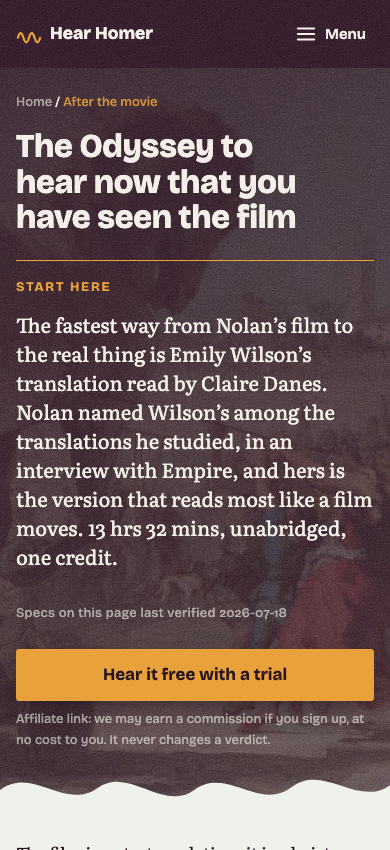
- Decision
- Lead with one recording a listener can choose.
- Visible proof
- The opening names Emily Wilson's translation read by Claire Danes.
- Limit
- The capture shows the recommendation. It can't show whether the film claim behind it stays accurate.
Captured at phone width on . The live page may have changed.
Check the current page